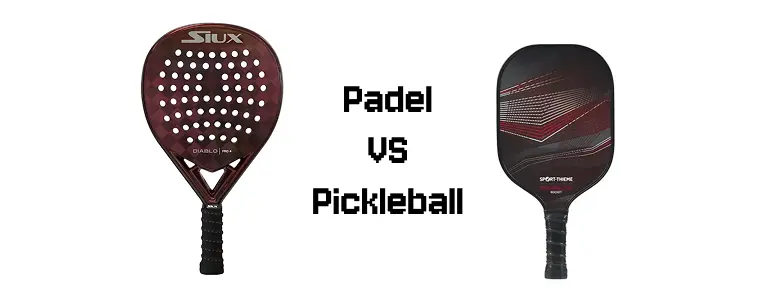
Padel vs Pickleball: What are the main differences?
There is a huge hype going on for both padel and pickleball. But what makes padel vs pickleball unique? You will also see it searched the other way round as pickleball vs padel, and sometimes as padel tennis vs pickleball, but it is all the same comparison. From the courts to the gear and how you actually play, there are some pretty big differences between padel and pickleball that make each sport its own thing.
So is padel the same as pickleball? Not really. They are cousins, not twins. Here is the full breakdown.
Main Differences Padel vs Pickleball
Here is a summary table of the main differences between padel and pickleball.

- Padel has walls that are used during the game. Pickleball is played on an open court
- Padel uses a solid pala. Pickleball paddle is flat, similar to a table tennis paddle
- Padel has a less pressurized tennis-like ball. Pickleball has a plastic ball with holes
- Padel has the traditional tennis scoring. Pickleball plays to 11 points and only the serving team can win points.
- Padel is usually played in doubles. Pickleball can be played as singles or doubles.
- Pickleball is huge in the US, while padel leads in Europe and Latin America.
Padel has walls and Pickleball has no walls
Both courts are completely different, which heavily affects the playstyle, the strategies used during gameplay, and player fitness as well. This is the first thing you notice in any padel court vs pickleball court comparison.
Padel tennis has an enclosed court
Below you can see an image of a padel court.

Padel court is like a mini tennis court, but it has walls around the court. Padel courts are usually surrounded by glass (sometimes with concrete) at the back and metal fences on the sides. The glass walls can be used during play, similar to squash. About the fences. If the ball bounces off the ground and hits the fence, it is still in play. But the fence can be very tricky since you can't predict which direction the ball will fly after it has hit the fence. Padel courts are bigger than pickleball courts. Padel court dimensions are around 10 meters (33 feet) wide by 20 meters (66 feet) long. Since you can use the glass walls in padel, it can make for some really long rallies because you have got more room to work with.
Pickleball has an open court
Pickleball courts, on the other hand, are way simpler.

Pickleball courts are the same size as a doubles badminton court, about 6.1 meters (20 feet) wide and 13.4 meters (44 feet) long. Pickleball courts don't have walls like padel does. The court just has lines. If the ball goes out, it is out. In padel the ball can bounce off the glass and it is still in play. The interesting thing on pickleball courts is this area called the "Kitchen". It is right by the net. It is about 7 foot deep, and the trick is, when you are in the kitchen, you can't hit the ball while it hasn't bounced yet. It stops people from just smashing every ball. Instead you are forced to play softer shots or "dinks" while you are in the kitchen. So when you are at the net, precision is really important and having quick hands helps a lot.
So the padel vs pickleball court size difference is big. A padel court is 10x20m, while a pickleball court is roughly 6x13m, about a third of the size. That is why padel feels like a running game and pickleball feels like a reaction game.
Pickleball has a hard court and padel has a soft one
Another key difference is the court surface.
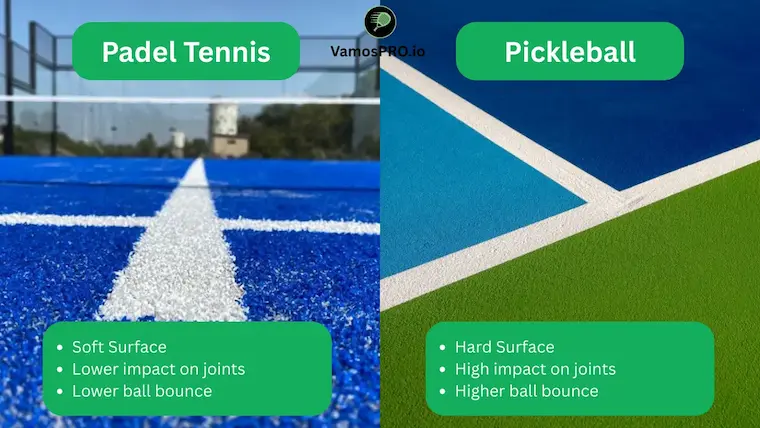
Padel is played on sand-dressed artificial turf, which is softer underfoot and lets you slide a little into shots. Pickleball is usually played on a hard court, the same kind of asphalt or acrylic surface you find on a tennis or basketball court. The softer padel surface is one reason a lot of players find padel easier on the knees.
Padel vs Pickleball Rackets
They might look similar-ish, but both types of rackets are actually pretty different, and it does change the way you play the sport.
Padel's Solid Pala
Padel racquets are thick and solid. They don't have strings like tennis racquets. Padel racquets have a dense foam core like EVA or polyethylene. They are covered with carbon fiber or fiberglass.
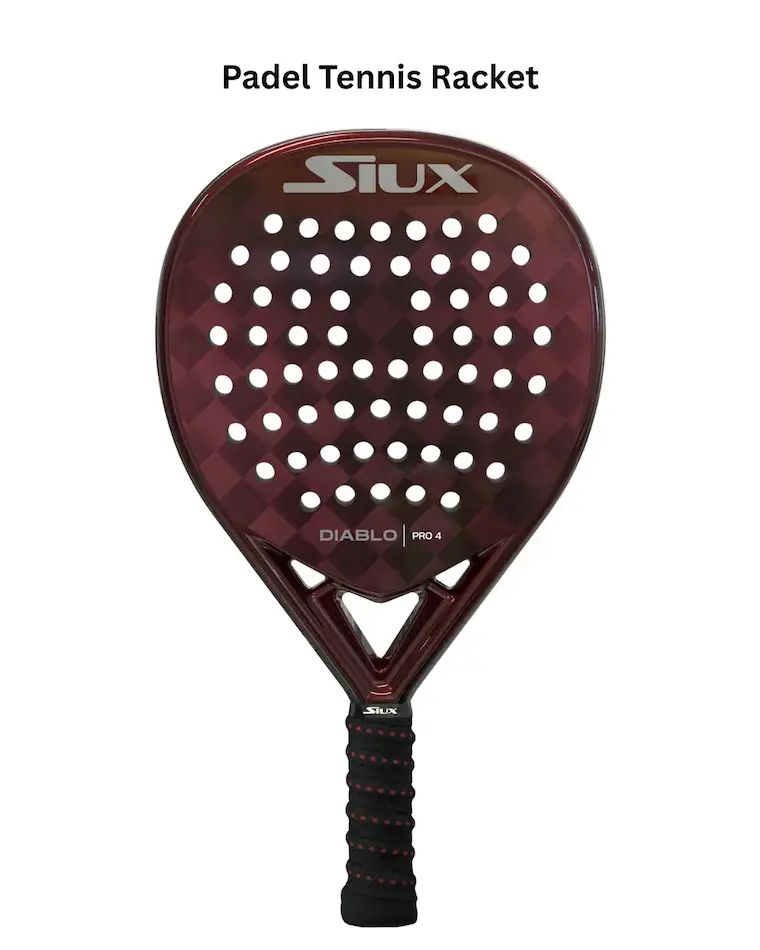
The face of the pala also usually has holes for aerodynamics and grip. Padel racquets feel sturdy. When you connect with the ball just right, you can really generate a lot of power.
Different Types of Padel Rackets
In padel there are also different types of rackets. Each of them is tailored to a different playstyle.

There are 3 types of padel rackets: Teardrop (hybrid), Round and Diamond. In general, padel rackets differ in their shape, weight, material, and foam.
- Shape - manoeuvrability and play style;
- Weight - manoeuvrability and the amount of power;
- Material - comfort and power;
- Foam - comfort, control and power.
So each aspect of the racket affects its performance. It is often recommended for players to try out different rackets since every player is different. In professional play, as of 2026, the teardrop shape racket is used most often since it is the most versatile one.

Pickleball's Flat Paddle
Pickleball paddles are like oversized ping-pong paddles.

They are thinner and lighter than padel palas. The core is usually a honeycomb structure, often made of polymer, and the face is typically fiberglass, carbon fiber, or graphite. The sound the paddles make is really distinct. It is a certain "pop" when you hit the ball. Pickleball paddles focus on touch and control, especially for those tricky dinks in the kitchen. In pickleball you are not trying to smash the ball as sometimes you would do in padel, but instead you are focusing on placing the ball perfectly. It is a positioning, placement and quick hands game.
Padel vs Pickleball ball differences
When you compare the padel ball vs pickleball ball, they could not be more different. And if you search it the other way, pickleball vs padel ball, the answer is the same.

- Padel Ball: It looks just like a regular tennis ball, but it is not. It is slightly smaller and has less internal pressure. So it doesn't bounce as high as a tennis ball, which keeps the game fast.
Also, there are two types of padel balls: "fast balls" and "slow balls". The difference is the pressure in the ball. More pressure in the ball, the faster the ball becomes, and vice versa. So depending on what type of padel you like (fast or slow), you can use the right balls for your play style.
- Pickleball Ball: A hollow plastic ball with holes in it. It looks like a wiffle ball. It doesn't fly fast since it has those holes. The ball is heavily affected by wind, and doesn't bounce that much. This is one of the main reasons why pickleball is more about finesse and quick hands than power.
Rules of padel vs pickleball
Let's look at how these games actually work. They are quite different.
Serving styles
The serve is how you kick off a point. Both sports don't have any crazy overhand aces like in tennis. Both sports require an underhand serve, meaning you have to hit the ball at or below your waist.
- Padel: You toss the ball and you have to let it bounce once on your side of the court before you hit it. You focus on serving the ball with control.
- Pickleball: You hit the ball out of the air, usually with a bit of a forehand arc, but still underhand. No bounce needed before you serve.
This underhand rule slows the game down and makes the serve less of a weapon (versus tennis). In padel and pickleball the serve is about starting the rally strategically.
Scoring Systems Compared
Padel has the classic tennis scoring. 15, 30, 40, deuce, advantage, game. Matches are best of 3 sets, and you need 6 games to win a set. Pickleball games are played to 11 points. To win, you have to have a 2 point advantage. Only the serving team can score points. If you miss your serve or lose the rally when you are not serving, you just "side out" and then the other team serves. So in pickleball it is really important to hold the serve.
The Kitchen Rule in Pickleball
This is probably the most famous rule in pickleball. It is called the "Non-Volley Zone", but everyone just calls it "The Kitchen". It is a 7-foot area right next to the net on both sides. Here is the deal. You cannot hit the ball in the air (that is a volley) if any part of your body is inside the Kitchen. You have to let the ball bounce first if you are in there. This rule stops players from just standing at the net and smashing every ball. It forces softer shots, like "dinks", and makes you think way more about placement and patience. It is what makes pickleball so accessible and less about pure power.
Gameplay Dynamics
In the padel vs pickleball matchup, the two play totally differently. Let's look at the core mechanics that make both sports so unique.
Padel Glass Wall Play
Because you have got those glass walls surrounding you, the game gets this whole extra dimension.

You can use the glass walls to your advantage. A shot that might be a winner in tennis or pickleball could just bounce off the back glass wall in padel and the point is still live. So rallies can be really long. This also means you are constantly moving. Learning to read the ball when it bounces off the wall is the trickiest part. Tennis is a game of winners. If you hit the ball hard and fast you will win the point. Padel, on the other hand, is a game of no mistakes. You need to be strategic about your points. It is not just about hitting hard and fast. Quite the opposite. You need to build the point and take it when the ball is right.
Pickleball's Quick Hands
Pickleball is way more about reflexes and placement, especially around that infamous "kitchen" zone. You can't just stand there and smash the ball. Instead of big, powerful shots, you have these super fast, delicate exchanges called "dinks". It is like a rapid-fire game of chess at the net. You are trying to place the ball perfectly, keep it low, and wait for your opponent to mess up.
Physical Intensity
- Padel: Because of the walls and the constant movement, padel can be a pretty intense cardio workout. You are covering a lot of court, reacting to unpredictable bounces, and it feels like a full-body effort. It can get pretty explosive.
- Pickleball: Pickleball is generally less demanding physically, especially with the running. The smaller court and the Kitchen rule mean you are not usually sprinting around. It is more about agility, quick footwork in a small area, and good hand-eye coordination. This makes it very accessible for a wide range of people, but you can still get a good workout if you play intensely.
Padel vs Pickleball Popularity
One of the most searched angles is pickleball vs padel popularity, so where does each sport actually win?
Pickleball is the US story. It is often called America's fastest-growing sport, with tens of millions of players, most of them in the United States and Canada.
Padel is the global one. It has around 30 million players across more than 130 countries, and it is strongest in Spain, Argentina and Italy, with the rest of Europe and the Middle East catching up fast.
So the honest answer on padel sport vs pickleball is that popularity depends on where you live. In North America, pickleball is everywhere. In Europe and Latin America, padel is the one taking over.
Frequently Asked Questions
What is padel vs pickleball?
Padel vs pickleball is a comparison of two of the fastest-growing paddle sports in the world. Both grew out of tennis and both are easy to pick up, but padel is played on an enclosed walled court while pickleball is played on a small open court. The rest of this guide breaks down every difference.
Is padel the same as pickleball?
No. Padel and pickleball are both paddle sports that grew out of tennis, but they are not the same. If you want a primer on what padel is before comparing, start there. Padel is played on a bigger walled court with a bouncing ball and tennis scoring. Pickleball uses a smaller open court, a plastic ball with holes, and its own scoring to 11. So while the two get compared constantly, they are related but play completely differently.
What is the difference between padel and pickleball?
The main difference is the walls. In padel the ball stays live off the glass, so rallies last longer. Pickleball has no walls and a non-volley zone at the net called the kitchen. Whether you search it as the difference between padel and pickleball or the difference between pickleball and padel, it comes down to the walls, the court size and the ball.
What is the difference between a padel court and a pickleball court?
The padel court vs pickleball court gap is size and walls. A padel court is a 10x20m box enclosed in glass and mesh, and those walls are in play. A pickleball court is open with a net in the middle, about 6x13m, roughly a third of the size. That padel vs pickleball court size difference is why padel involves more running.
How is the serve in padel versus pickleball?
Both sports have an underhand serve, which means you hit the ball below your waist. The main difference is that in padel you have to let the ball bounce once before you hit your serve. In pickleball you hit the ball out of the air with a little upward arc.
What is the scoring like in these games?
Padel uses a scoring system that is just like tennis, with 15, 30, 40 and games and sets. Pickleball games are usually played to 11 points, and only the team that is serving can score a point.
Which sport is more popular, padel or pickleball?
It depends on the region. Padel has really taken off in Europe and Latin America, especially Spain and Argentina. Pickleball is huge in North America, above all in the United States and Canada. So the pickleball vs padel popularity question mostly comes down to which continent you are on.
Which one is more physically demanding?
Padel can be pretty intense because the walls make the rallies longer and you are constantly moving around the court. Pickleball is more about quick hands and reflexes, with less running, which makes it easier on the body.
Padel vs pickleball: which should you play?
If you have courts nearby, try both. Pick pickleball if you want the gentlest possible start and lots of quick social games. Pick padel if you want longer, more athletic rallies and you like the idea of using the walls. If you're weighing padel against tennis instead, the padel vs tennis breakdown is a good next read. Most people who try padel vs pickleball end up hooked on whichever one their friends already play, so the real answer is to grab a court and see which one clicks — and once you're playing, analyse your padel game to see what actually improves.